Pursuing Good: Surprise

pursuinggood_surprise

In my recent post Pursuing Good: The Backstory, I began to process what makes something good. I ran into a couple of articles that really helped propel this idea forward. I even started to address the bad press we give good as opposed to great or excellent. I’ll continue to focus on that tension.

We already looked at authenticity. In this article I want to tackle the second characteristic in my master list of what makes something good:

A service is good when it is surprising.

As usual, let’s define this word in an effort to get on the same page.

Keep thinking! Continue reading.

Great Conversations: Jesus and Pilate

Great Conversations_Jesus and pilate

It has been my conviction shared in many conversations that Jesus did not directly confront the Roman empire. Instead, his focus was on Israel, their failure to repent and follow God, and the judgment they were under, thus Rome.

Consider this famous passage in Mark 12

13 Later they sent some of the Pharisees and Herodians to Jesus to catch him in his words. 
14 They came to him and said, “Teacher, we know that you are a man of integrity. You aren’t swayed by others, because you pay no attention to who they are; but you teach the way of God in accordance with the truth. Is it right to pay the imperial tax to Caesar or not? 
15 Should we pay or shouldn’t we?” But Jesus knew their hypocrisy. “Why are you trying to trap me?” he asked. “Bring me a denarius and let me look at it.” 
16 They brought the coin, and he asked them, “Whose image is this? And whose inscription?”“Caesar’s,” they replied. 
17 Then Jesus said to them, “Give back to Caesar what is Caesar’s and to God what is God’s.”And they were amazed at him.
Sermons should be developed just based on the flattery they bestow upon Jesus before asking him their “question.” I wonder if our opinion of Jesus often matches theirs. If so, we are missing the point, as His answer demonstrates.
The way I see it Jesus is once again calling them into account for not properly responding to God. The reason they are having to pay the Imperial Tax at all is because they are under judgment. In essence His two-fold answer is pointed in the same direction: Submit to Caesar as he is an instrument in God’s justice and in doing so, submit to God and the work He is doing in the world  (which will entail repentance and new living).
Be that as it may be, although Jesus is not directly confronting Roman rule and any abuse committed by Rome as he answers this question, He is definitely confronting them and their politics which are keeping them from properly responding to God and His rule.

Keep thinking! Continue reading.

Pursuing Good: Authentic

pursuinggood_authentic

In my recent post Pursuing Good: The Backstory, I wanted to begin to process what makes something good. I ran into a couple of articles that really helped propel this idea forward. I even started to address the bad press we give good as opposed to great or excellent.

More on that later.

In this article I want to tackle the first in my master list of what makes something good:

A service is good when it is…

  1. authentic.
  2. surprising.
  3. exposing vulnerability.
  4. interesting (with a by product of engagement).
  5. appropriate.
  6. complete or full (delivers on the expectation).
  7. special.
  8. smooth in transitions.
  9. purposeful (or communicating a point).
  10. impeccably executed.

A service is good when it is authentic.

Don’t just read past this one as something that you already know. There is more to the story here.

Keep thinking! Continue reading.

Pursuing Good: The Backstory

pursuinggoodheader

When is something good? How do we know we are doing good work?
Is there an objective standard that church technical artists can use to make sure the effort that we are putting in is paying off?
How do we know if our transitions are good? Or the infrastructure we are adding to the word and worship is good?
Ultimately, it’s really about the service itself, as an entity, how do we know it is good?

Keep thinking! Continue reading.

I Beg Your Indulgence

95thesis

The longer I live, the more I serve Christ, the more I am compelled to take a long view of history and an eternal perspective toward the few small years comprising our life on earth. I love the emphasis I often hear calling for increasing the Church’s role in societal restoration. These are big issues and range in areas diverse as long-standing nationalistic enmity, to racism and racial disagreement and distrust, to environmental awareness and care, and the list goes on. This adjustment seems to me to be the right track. After allowing the pendulum to swing too far to individual evangelism, it is appropriate to look at the church’s role in the world that goes beyond just trying to get people to say the sinner’s prayer.

I also recognize that this is perhaps uniquely an evangelical problem. And an American Evangelical problem at that. Mainline churches, for all of the flack they catch from others in the evangelical community, are now being seen as a source of some stabilizing and “successful” practices: liturgy, comprehensive catechism, and this stance of social restoration that I am talking about. It’s almost as if the younger brother is just now waking up to the family business that has been going on for hundreds of years. At least that’s what it feels like in the church circles I move in.

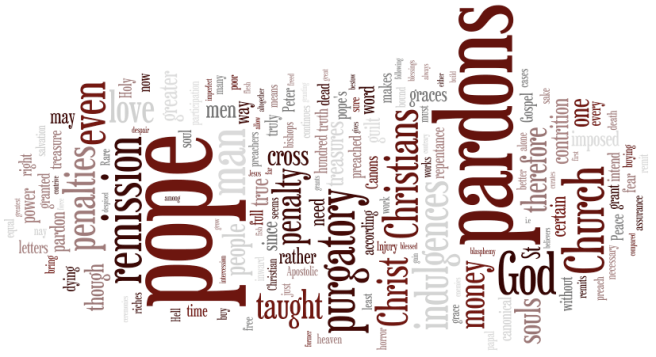
With that caveat in mind, I must confess, I’ve been thinking a lot lately about indulgences. You know, those things we were taught to protest against as Protestants. You know, those things that caused Martin Luther to nail 95 Theses to a door.

Yeah, those.

Keep thinking! Continue reading.