Maybe We Don’t Have a Discipleship Problem

As a person who has spent their whole life in church and working in church and ministry, I have been an advocate to anyone who would listen that we have a gigantic discipleship problem in Evangelical and Evangelical adjacent places. I now believe I am wrong.
[*If you need it, see below for a caveat.]
Here’s what I’m thinking.

What is Discipleship?

Discipleship is a Christ-followers active engagement to discern God’s will and voice for themselves and then obey in a lifestyle of sacrificial love with Jesus as our model. There are practices (or habits, or disciplines) that we adopt to maintain that connection to the Holy Spirit. The simple ones are prayer, Bible study, and fellowship and commitment to other followers of Christ. There are more of course.
None of this should be revolutionary.

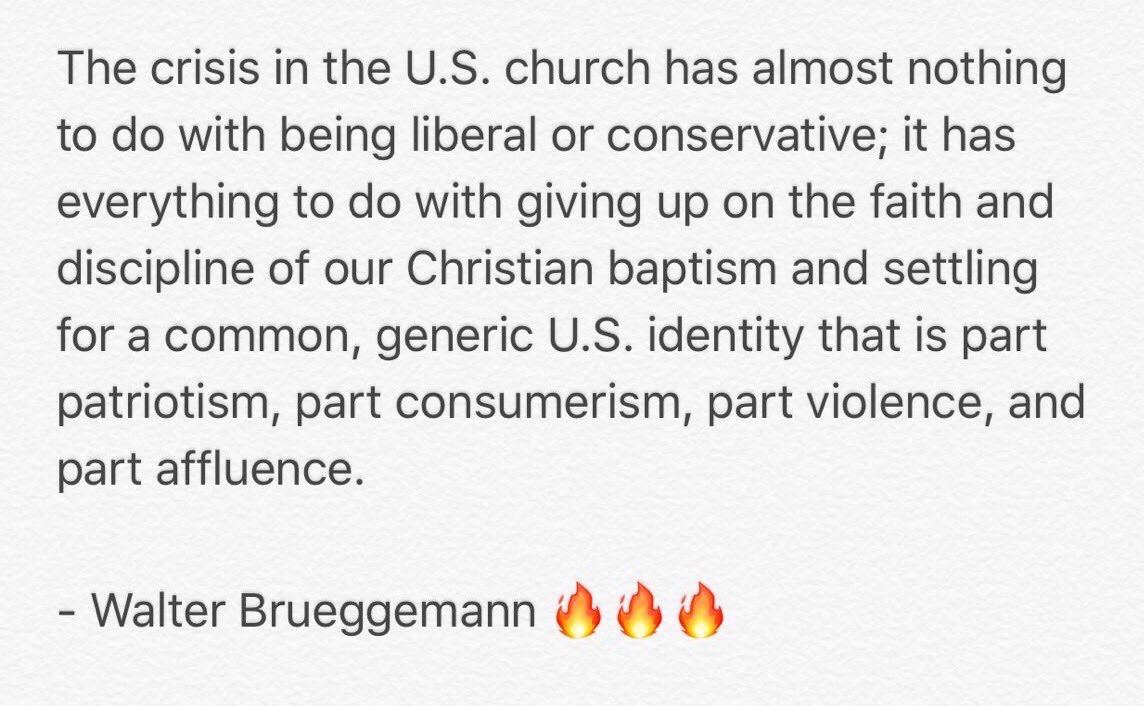
We have generations of American church goers that are nominally christian but have little evidence that they are involved in this discipleship process, but (and here is the big kicker) they have evidence that they are adherents to American civil religion: a form of patriarchal, family values; consumerism/materialism; militarism; and being a good, white, middle class person. It is a syncretism between western culture’s definition of liberty with biblical sounding names. Perhaps first century Christians had it easier with Rome’s clear paganism and idolatry while we have ours wrapped in centuries of Christian language. Perhaps.
A Note About Systems

Systems are perfectly designed to produce the results they produce. This is axiomatic. We often call a system broken or dysfunctional when it is producing unwanted results. In one way this is true, in another way it is not. The system needs to be seen as working properly. Generally, in my experience, we lay the blame at the feet of people who, we say, are not following the program. Instead, if there is a problem, and I am drawing a fine hair distinction here, it is that we have a system that is working as it is designed to do—but it is committed to the wrong set of principles and goal.

Said another way, in many churches, our discipleship systems are working properly if the goal is to create adherents of American civil religion, because that is what they are producing. While our systems are dysfunctional (if the goal is Christ-followers), it is not true that they are not working as designed. The systems are working well. That is what we must come to see. I have spent most of my time thinking the systems are not working. This is where I have been wrong.

  • Church leaders are bowing at the feet of corporate principles, but lack the courage to challenge their congregations to the revolutionary lifestyle that models Jesus. What does it profit to grow your church and lose your soul?
  • Christians hold the American flag as sacred and pledge allegiance to what it embodies. Sacred means connected with God (or the gods) or dedicated to a religious purpose and so deserving veneration (Apple’s dictionary). That’s idolatry for those who profess allegiance to Christ.
  • Women are denigrated to second class status and denied their full humanity… in churches!
  • The most racist segments of our society are so-called Christians who find justification in the same Bible interpretations employed by enslavers of 200 years ago. The KKK was an America-first organization that wanted to return to a “Christian” hierarchy. It has many adherents today, although they don’t have the courage to go by that name they have adopted the Christian Nationalism label and written books in defense of this ideology.

All of which is never challenged in our sermons and Bible study materials. In fact, it is propagated in our materials. The system is working as designed. We ought to know better.

So What’s the Antidote?

Though perhaps hard to hear, much of what we say is Christian is simply not. This is why I have been a fan of deconstruction. The closer you get to Jesus, the more you realize you cannot stay within a false religion. Do some take it too far? Perhaps. Better than not far enough, I say. Wildfire is better than no fire. I’ll take a radical pursuit of good over status quo compromise any day.

4 Then I heard another voice from heaven say:

“‘Come out of her, my people,’[a]
so that you will not share in her sins,
so that you will not receive any of her plagues;

Revelation 18:4

We need to shake the dust off our feet from a compromised, American civil religion/Christian Nationalism/slaveholder religion and recommit to the Kingdom of God’s shalom.

There are a few principles that I believe would be prescriptive for those who are looking for a cure and truly want to follow Christ:

  • Eschew fundamentalism and anti-intellectualism. I am happy to see a resurgence among average Christians in scholarly conversations about the Bible. Podcasts seem to be helping this as more people are made aware of these conversations and they are more accessible to the average person like me. We need a more robust interpretation of scripture that doesn’t prop up our cultural compromises. OnScript and The Bible for Normal People and the Jude 3 Project are good resources here.
  • I would like to see more practical help in developing a personal prayer life. Not the quiet time of my youth, but an engaging, contemplative union with Jesus. Brian Zahnd’s prayer school is the kind of thing I am thinking about. Here’s a link to some of his thoughts on prayer.
  • We need to submit to leadership that is outside the rutted grooves of white evangelicalism and the stranglehold of white supremacy. This means non-white leadership. Yes, I am making a blanket statement. It is not an accident that Black Christians in America continue to outpace other groups in orthodoxy, Bible reading, and prayer. For many of us, we need to relearn what it means to be a Christ-follower, so let’s go to where the real Christians are and submit to their leadership.

Begin here, the rest will take care of itself. If you seek, you will find. If you knock the door will be opened.

Conclusion

We don’t have a discipleship problem, we have a competing religion functioning as designed all around us.

Resources for further reflection:

  • Reconstructing the Gospel: Finding Freedom from Slaveholder Religion
    by Jonathan Wilson-Hartgrove
  • Jesus and John Wayne: How White Evangelicals Corrupted a Faith and Fractured a Nation
    by Kristin Kobes Du Mez
  • The Making of Biblical Womanhood: How the Subjugation of Women Became Gospel Truth
    by Beth Allison Barr
  • Was America Founded as a Christian Nation?
    John Fea
  • The Color of Compromise
    Jemar Tisby

*Caveat
I can hear someone saying, “NOT ALL, Mike,” as they read this. OK. Fine. Sure there are faithful Christians still in these places. That’s who I’m writing to.


A New Definition of Leadership

Before we get started, it may be good idea to explore what we are talking about. Some people do not like the word leadership in reference to Christians. After all, we should be servants. While that is true, the Bible uses the word leader to talk about people serving the church body. What is leadership?

1 Tim 3:1 — “Here is a trustworthy saying: Whoever aspires to be an overseer desires a noble task.”
Being an overseer is noble, not inherently wrong.

Heb 13:7 — “Remember your leaders, who spoke the word of God to you. Consider the outcome of their way of life and imitate their faith.”
Here leaders are spoken of highly and considered a model for behavior.

Rom 12:6–8 — “We have different gifts, according to the grace given to each of us. If your gift is prophesying, then prophesy in accordance with your faith; if it is serving, then serve; if it is teaching, then teach; if it is to encourage, then give encouragement; if it is giving, then give generously; if it is to lead, do it diligently; if it is to show mercy, do it cheerfully.”
Here leadership is listed as a gift given by God. They are admonished to lead diligently.

1 Tim 5:17 —  “The elders who direct the affairs of the church well are worthy of double honor, especially those whose work is preaching and teaching.”
Those who lead, and do it well, are worthy of good pay and respect.

Mark 10:42–45 — Jesus called them together and said, “You know that those who are regarded as rulers of the Gentiles lord it over them, and their high officials exercise authority over them. Not so with you. Instead, whoever wants to become great among you must be your servant, and whoever wants to be first must be slave of all. For even the Son of Man did not come to be served, but to serve, and to give his life as a ransom for many.”
Here the kind of leadership is emphasized, but not the negation of leadership. We are to look like Jesus and serve others. That is how we lead.

I would contend that it is always right to examine ourselves and question whether what we are doing is right and just and of God. Although there are many examples of failure all around us, I am more interested in scripture holding up a mirror to my soul and being honest about what I see there. Things should look like the Kingdom of God inside of me and inside of the church. Too often they look similar to what is going on around us in culture. Leadership in my mind simply means those going first and out front, and if we couple that with a culturally-informed, conquering, superiority mindset, we get into all sorts of trouble.

Keep thinking! Continue Reading,

Pursuing Good: Appropriate

pursuinggood_appropriate

I remember visiting a church with my family following the horrific attacks of 9/11. To be honest, I was not completely sure how I was feeling. I am sure you can relate. How odd was it that this church barely mentioned those events and did not seem to alter their service in any way. I left with nothing. Whatever that service was, it was not good… and we never went back.

I live within a few miles of Charlotte, NC. Recently our city made national news with the tragic police shooting of Keith Lamont Scott and the subsequent protests. This was a time to stand with people who were hurting, to prophetically speak to power, and pray for our police officers. Among the members of our church, we had police officers assisting in the crowd control and congregants joining the protests! I didn’t say this was easy. That’s a lot of emotion to deal with. (And please forgive me for using this tragedy as an illustration. I know how intense it is and that is what makes this conversation about our ministry so critical. Of course I feel that weight. I’m feeling it now.) In fear of not offending anyone or fear of saying the wrong thing, I shudder to think how many congregations completely ignored the entire thing. Shameful.

These examples reveal responses that were neither suitable nor proper (the very definition of appropriate).

If you recall the backstory behind these pursuit of good posts, the example that sparked it all was examining what made an actor good. The characteristic about being appropriate had everything to do with body language and how an actor uses their body as an instrument to convey what is appropriate in a scene. This is an apt metaphor. Are we comfortable in our own skin as the body of Christ?

To be appropriate, we need both emotional range and spiritual fortitude/muscle to wade into these deep waters.

Keep thinking! Continue reading.

Pursuing Good: Complete

pursuinggood_complete

In my recent post Pursuing Good: The Backstory, I began to process what makes something good. I ran into a couple of articles that really helped propel this idea forward. I even started to address the bad press we give good as opposed to great or excellent. I’ll continue to focus on that tension.

Here are the characteristics of a good service. A service is good when it is…

  1. authentic
  2. surprising
  3. exposing vulnerability
  4. interesting (with a by product of my engagement)
  5. appropriate
  6. complete or full (delivers on the expectation)
  7. special
  8. smooth in transitions
  9. purposeful (or communicating a point)
  10. impeccably executed

In this post, let’s do a deeper dive in #6—a service is good when it is complete. As usual, let’s start with a definition to get on the same page:

complete |kəmˈplēt| adjective
having all the necessary or appropriate parts
• entire; full
• having run its full course
(often used for emphasis) to the greatest extent or degree; total
Apple Dictionary v2.2.1

Let’s go.

Keep thinking! Continue reading.

Great Conversations: Jesus and Pilate

Great Conversations_Jesus and pilate

It has been my conviction shared in many conversations that Jesus did not directly confront the Roman empire. Instead, his focus was on Israel, their failure to repent and follow God, and the judgment they were under, thus Rome.

Consider this famous passage in Mark 12

13 Later they sent some of the Pharisees and Herodians to Jesus to catch him in his words. 
14 They came to him and said, “Teacher, we know that you are a man of integrity. You aren’t swayed by others, because you pay no attention to who they are; but you teach the way of God in accordance with the truth. Is it right to pay the imperial tax to Caesar or not? 
15 Should we pay or shouldn’t we?” But Jesus knew their hypocrisy. “Why are you trying to trap me?” he asked. “Bring me a denarius and let me look at it.” 
16 They brought the coin, and he asked them, “Whose image is this? And whose inscription?”“Caesar’s,” they replied. 
17 Then Jesus said to them, “Give back to Caesar what is Caesar’s and to God what is God’s.”And they were amazed at him.
Sermons should be developed just based on the flattery they bestow upon Jesus before asking him their “question.” I wonder if our opinion of Jesus often matches theirs. If so, we are missing the point, as His answer demonstrates.
The way I see it Jesus is once again calling them into account for not properly responding to God. The reason they are having to pay the Imperial Tax at all is because they are under judgment. In essence His two-fold answer is pointed in the same direction: Submit to Caesar as he is an instrument in God’s justice and in doing so, submit to God and the work He is doing in the world  (which will entail repentance and new living).
Be that as it may be, although Jesus is not directly confronting Roman rule and any abuse committed by Rome as he answers this question, He is definitely confronting them and their politics which are keeping them from properly responding to God and His rule.

Keep thinking! Continue reading.